The whales and dolphins you may meet off Madeira
The sea off Funchal drops to deep water within a few miles of the marina, which is why so many whales and dolphins turn up close to the island. This guide covers the species you may meet and how to recognize them from the deck, season by season. None of them is ever guaranteed.
More than 20 species, in deep water close to shore
More than 20 species of whale and dolphin have been recorded in the waters around Madeira, and some listings put the figure higher. The reason sits under the boat. The seabed drops steeply off the south coast, so open ocean starts only a few miles from Funchal Marina.
That depth is why a two- or three-hour trip can reach animals that elsewhere need a long day at sea. It also means the cast changes from one day to the next, and no operator can promise which species will show up, or that any will.
The spotters on the cliffs help. Madeira hunted sperm whales until 1981, and the old whalers' lookouts gave rise to today's land-based spotters, who radio the boats when they see a blow. The Whale Museum in Caniçal, east along the coast, tells that history in more depth.
Pilot whales and bottlenose dolphins, the regulars
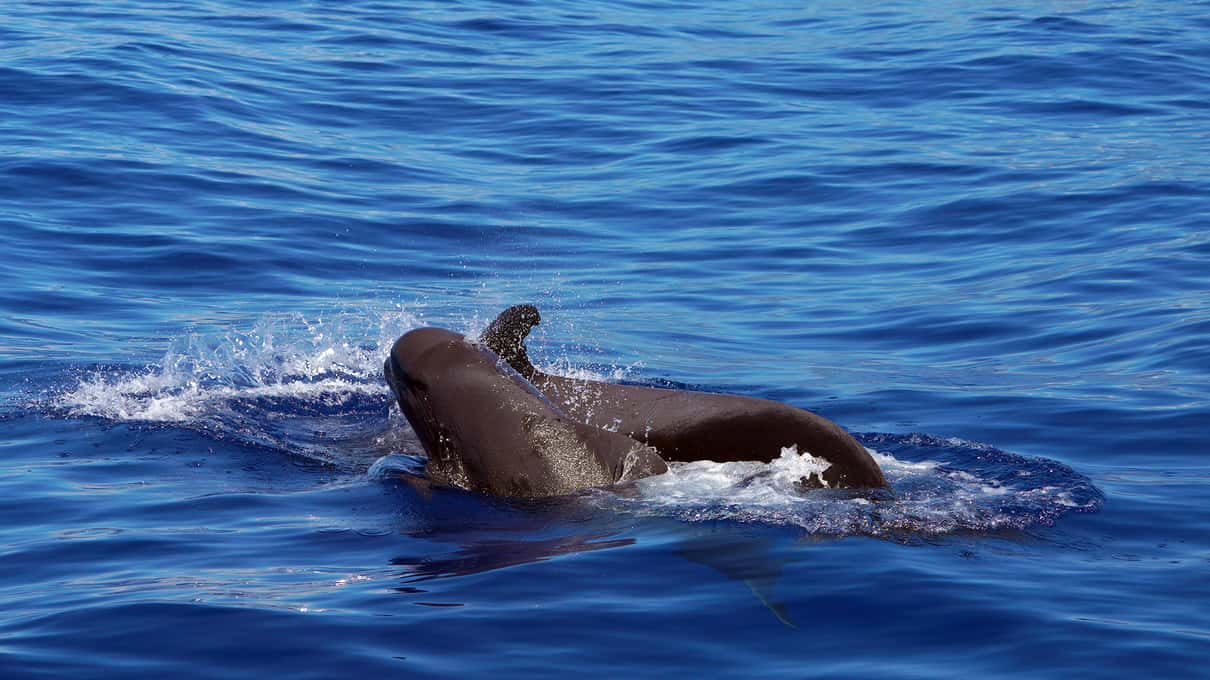
Short-finned pilot whales live around Madeira for all or most of the year, and reviews on our five listings mention them more than any other whale. They are dark, and each has a rounded forehead plus a low, broad fin set well forward on the back.
Pilot whales usually travel in family groups, so one sighting often means several backs rising together. They can lie still at the surface to rest, which gives a slow, close look rather than a two-second glimpse.
Bottlenose dolphins are the other near-resident. They are bigger and greyer than the other dolphins here, and a group will often come across to ride the pressure wave in front of the bow.
Dolphins that come and go with the seasons
Atlantic spotted dolphins are seen mostly in the warmer months. Adults carry pale spots that grow denser with age, and they tend to travel in lively groups that leap clear of the water.
Common dolphins take over in the cooler months, often in larger groups. Look for the yellowish hourglass pattern along the flank when one surfaces beside the hull.
The pattern is a tendency rather than a timetable, and our seasons guide sets out the months. The optional swim on Xpoint's RIB is allowed only with these two species, as the dolphin swim guide explains.
Sperm whales, the prize
The sperm whale is the animal most people hope for, and it turns up off Madeira in many months. Sightings come more often in spring and summer. It is the largest toothed whale, with a huge square head and a wrinkled grey back.
A sperm whale spends long stretches deep below, then rests at the surface to breathe. Its blow angles forward and to the left, which a spotter can pick out from high on the cliffs. When it dives again, the tail rises clear of the water, the moment every camera waits for.
Reviewers on Blue Safari and Magic Dolphin both describe sperm whale days, and plenty of others describe trips with none. Count one as a bonus. If you come back without any whale at all, when the whales stay away covers the retry offers.
Baleen whales passing through
Bryde's whales are seen off the island in summer. They show a long, slim grey back with a small curved fin, and they can surface with very little blow to give them away.
In spring, larger baleen whales sometimes pass Madeira on migration. Fin and sei whales are reported in some years, with the odd blue whale too. These sightings are rare and short, so read them as luck and never as part of the plan.
Turtles and other extras
Loggerhead turtles drift near the surface on calm days, looking like a floating brown dome until a head pops up. Flying fish skim away from the bow in long glides, which children on board tend to love, as our guide to whale watching with kids mentions.
Seabirds follow the boats and the fish. Cory's shearwater is the one you will see most, gliding low over the swell on stiff wings, and a crowd of birds on the water can point the crew toward feeding dolphins.
Mediterranean monk seals live on the Desertas Islands south-east of Madeira and are rarely seen near Funchal. One Xpoint reviewer mentions meeting one, which counts as a remarkable piece of luck rather than something to expect.
Which trip gives you the closest look
The animals are the same for every boat, because all five leave from Funchal Marina and search the same stretch of coast with help from spotters. What changes is the time you spend searching and how close to the water you sit.
A fast boat such as Blue Safari's or Xpoint's RIB covers ground quickly with you low near the waterline. Gaviao's sailing trip from ~$45 is slower and covers less water, though it heads up to about 5 km (3 miles) offshore. Our boat guide puts the hull shapes side by side.
Under sail, with a swim at the cliffs
Gaviao Madeira takes up to 20 guests on a 3-hour trip by sailing yacht from ~$45. Drinks on board and snorkel gear for the stop at Cabo Girão are included. It is rated 4.7 from 1,500+ reviews on GetYourGuide, and the sail goes up only when the wind allows.
What you see from the deck
Most sightings start with a puff of spray on the horizon or a dark fin far off. The guide usually calls it out before most guests have found it, and the boat slows as it closes in.
Close up, dolphins often ride the bow, and pilot whales may stay near the boat for a while. Reviewers mention two boats at a time with the animals for about 10 minutes, so that window passes faster than you expect.
Leave the camera down for part of it. A phone held up through the whole encounter tends to catch splashes, while your own eyes catch the animals. Smaller boats give everyone room at the rail, as the small-group guide explains.