Madeira's whale calendar, month by month
Boats leave Funchal for whales and dolphins in every month, so there is no closed season to work around. What changes is the mix of animals, the warmth of the water and how often the wind cancels a trip. Pick your dates with those three in mind and book the boat early in your stay.
Boats leave Funchal in every month
Whale and dolphin trips sail from Funchal Marina all year, which sets Madeira apart from places with a short whale season. The five operators on this site list trips across the year, though rough days can cancel any single departure.
The reason is depth. The seabed drops away steeply close to the island, so deep-water animals such as short-finned pilot whales can feed within a few miles of the harbor.
Some species stay around most of the year and others pass through. Pilot whales and bottlenose dolphins count as resident or near-resident while the rest come and go. Our guide to Madeira's whales and dolphins takes them one by one.
No month guarantees anything. A good season shifts the odds a little, and every boat on this site has days with only dolphins or only whales. Some days the sea stays empty.
The year at a glance
The table sums up what tends to turn up when. Read it as a pattern drawn from operators' listings and reviews, not as a timetable the animals keep.
| Season | Often reported | Sea, roughly | The trade-off |
|---|---|---|---|
| Spring (around April and May) | Pilot whales, bottlenose dolphins, sperm whales more often; fin or sei whales pass on some days | Warming up | Baleen whales pass through and are never certain |
| Summer | Bryde's whales, Atlantic spotted dolphins, sperm whales, the residents | Warmest, up to about 24 °C (75 °F) | Busiest boats; no swim on Magic Dolphin's 9 am trip in July and August |
| Autumn | The residents, with summer species thinning out | Still mild | A mixed picture as the seasons turn |
| Winter | Common dolphins, pilot whales, bottlenose dolphins | Coolest, about 18 °C (64 °F) | More trips lost to wind and swell |
Spring and the passing baleen whales
Around April and May, larger baleen whales travel past Madeira on their long migrations. Fin and sei whales are reported in some springs, as is the occasional blue whale, though nobody can plan a holiday around them.
Sperm whales are seen in many months, with reports picking up in spring and summer. One breathes at the surface for a while before it lifts its fluke and dives deep, so the boat often waits for the next blow.
Spring days are mild and the boats are less crowded than in high summer. Pack a windbreaker anyway, because it gets breezy once you leave the shelter of the bay.
Summer brings spotted dolphins and warm swims
Summer is when Bryde's whales tend to appear, a fast baleen whale of warmer seas. Atlantic spotted dolphins are mostly a warm-month species too, often in lively groups that come to ride the bow.
The water is at its warmest, which makes the swim stops below Cabo Girão far more pleasant. Three of our five trips include a swim there, and Xpoint sells a separate dolphin swim add-on for days when the law allows it.
Summer is also the busiest time on the water. For July and August, book a few days ahead, above all on the smaller boats that take 17 to 20 guests.
Morning or afternoon departure
Departure times differ by operator and by day, so check the listing for your date. Magic Dolphin's eco catamaran from ~$39 offers both morning and afternoon departures on Viator, which helps if a flight or a levada walk takes half your day.
One detail matters in high summer. In July and August, Magic Dolphin's 9 am departure does not stop for swimming, so pick a later boat if the swim is part of your plan.
Morning seas are often calmer, though that is a tendency and not a rule. If you get queasy easily, an early boat pairs well with our tips on seasickness and what to bring.
A low-cost first go in any month
Magic Dolphin's hybrid catamaran is the least expensive trip we compare, and it has two decks and two toilets for up to 100 guests. A cheap first try leaves budget for a second one if the sea is quiet.
Common dolphins and swell in autumn and winter
In the cooler months common dolphins become more frequent, sometimes in large groups that move fast. Pilot whales and bottlenose dolphins stay around in winter as well, so a winter trip is far from empty.
The sea cools to roughly 18 °C (64 °F), and winter days on land sit around 17–19 °C (63–66 °F). On deck in the wind it feels colder, and Xpoint's listing asks for a warmer waterproof jacket on its RIB in winter.
The bigger winter cost is the weather. Swell and wind cancel more trips than in summer, and small boats ride rougher, a trade-off our page on boat types weighs up.
Autumn sits between the two patterns. The summer species thin out while the winter ones arrive, and on calm days the sea is still warm enough for a short swim.
Calm days come in every month
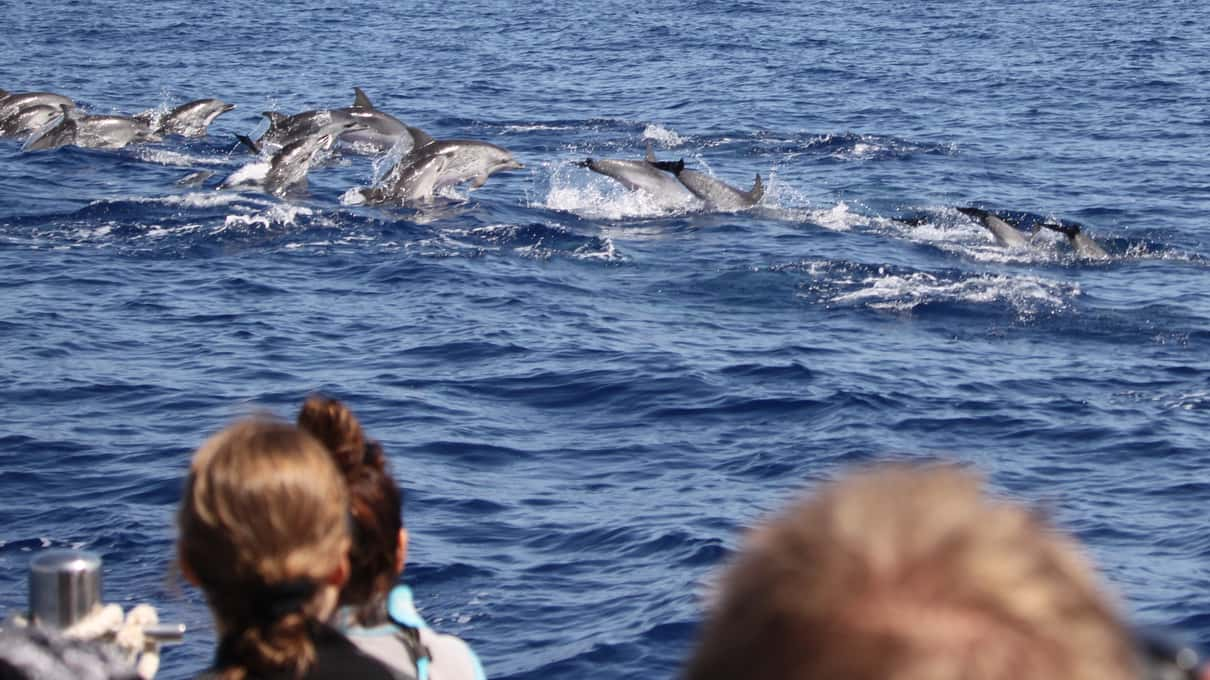
Madeira's mild climate means a flat, sunny morning can turn up in January and a choppy, windy one in August. The forecast for the days you are there matters more than the month you booked.
Operators cancel when the sea is unsafe and then reschedule or refund. Magic Dolphin's listing says so, and Gaviao offers another day or a full refund.
A boat that sails and finds nothing is a different matter. That case has its own page, when the whales stay away, with each operator's promise.
Book early in your stay
Whatever the month, put the whale trip on your first or second day in Funchal. A cancelled or empty outing can then be repeated later in the week.
All five trips on this site have free cancellation up to 24 hours before departure on GetYourGuide, and you can reserve now and pay later. That makes an early booking low-risk, and our guide to what a trip costs lines up the prices.
Blue Safari replaces a trip that finds nothing, and Xpoint offers a free retry within a year if there is space. On a short stay those promises only help if you leave a free day to use them.